Most entrepreneurs are searching for the big move. The breakthrough product. The viral launch. The investor meeting that changes everything overnight. Startup culture thrives on these moments, and the stories that dominate business media reinforce the idea that success arrives in dramatic bursts.
Yet talk to the founders who have actually built enduring companies, and a very different story emerges.
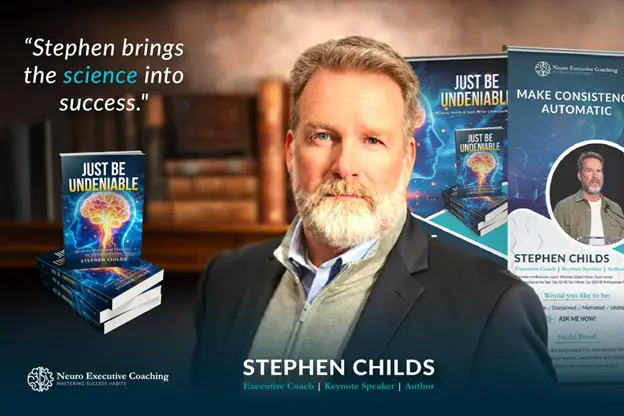
Stephen Childs has heard that story hundreds of times. As an executive coach, leadership strategist, and author whose work sits at the intersection of neuroscience and high performance, Childs has worked with founders and senior leaders across industries for two decades. And across all of those conversations, a consistent pattern emerges across many of these experiences.
"The real engine of success is rarely a single breakthrough," says Childs, whose coaching practice atNeuro Executive Coaching helps leaders build the habits and systems that make performance sustainable. "More often, it is the quiet accumulation of small improvements repeated day after day. The companies that look like overnight successes are almost always the result of years of disciplined, incremental progress happening behind the scenes."
The Lesson from Olympic Cycling
One of the clearest illustrations of this principle comes from an unlikely place. When Dave Brailsford became performance director for British Cycling in the early 2000s, the program had been largely irrelevant for nearly a century. Rather than chasing one revolutionary change, Brailsford focused on what he called the aggregation of marginal gains. His philosophy was straightforward: improve everything by just one percent.
The team redesigned bike seats for better comfort. They optimized sleep environments so athletes could recover more effectively. They refined nutrition plans, recovery strategies, and even taught riders the most effective way to wash their hands to reduce illness during competition season.
Individually, none of these adjustments seemed particularly groundbreaking. But collectively, they transformed the program. Over the next decade, British Cycling dominated Olympic competition and produced multiple Tour de France champions.
Childs draws a direct line from Brailsford's approach to what he sees in the most successful founders he coaches. "Sustainable success rarely comes from one massive improvement," he explains. "It comes from hundreds of small adjustments executed consistently over time. The founders who become undeniable are not the ones waiting for a breakthrough. They are the ones stacking small wins every single day."
Why Motivation Is the Wrong Foundation
Many founders struggle with incremental progress because startup culture glorifies motivation. The prevailing assumption is that progress happens when a person feels inspired, energized, and ready to attack the day. Childs argues this assumption is one of the most dangerous a founder can hold.
"Motivation is an unreliable fuel source," he says plainly. "Some days it shows up. Other days it disappears completely. If a business depends on motivation, performance will always be inconsistent."
The solution, in Childs' experience, is systems. Successful founders do not hope to find time for strategic thinking. They schedule it. They do not vaguely promise to build stronger customer relationships. They commit to consistent feedback loops. They do not chase bursts of productivity. They design routines that make meaningful work easier to repeat.
"Over time, those small systems create consistency," Childs says. "And consistency compounds."
In his bookJust Be Undeniable, Childs makes the neuroscience case for exactly this approach. Research by habit expert Dr. Wendy Wood suggests that roughly 43 percent of daily actions are driven by habit, according to behavioural studies on routine decision-making. The brain prefers efficiency. Once a behavior is repeated often enough, it moves into the brain's habit center and begins operating automatically, freeing up mental energy for more complex decisions. For entrepreneurs navigating constant uncertainty, this is an enormous advantage.
"Neuroscientists often summarize this process with a simple phrase," Childs notes. "Neurons that fire together wire together. The brain simply strengthens whatever patterns are rehearsed most often."
The Power of Micro-Habits
This is where Childs introduces one of the most practical tools in his coaching framework: the micro-habit. A micro-habit is a behavior so small it almost feels insignificant, yet when repeated consistently, it begins to reshape how someone operates.
For a founder, that might mean writing for five minutes each morning before checking email, reviewing one customer insight every day, or sending a single thoughtful message to someone in their network before lunch. These actions require very little time, but they create a rhythm. And rhythm builds momentum.
Over time, that momentum begins to shift identity. Entrepreneurs stop thinking of themselves as someone who is trying to build better habits. They start to see themselves as someone who executes consistently.
Childs also teaches a concept known as habit stacking, attaching a new behavior to something that already happens naturally in the day. The morning coffee becomes the cue to review priorities. Closing the laptop becomes the cue to reflect on the day's lessons. A team stand-up becomes the moment to identify one improvement for tomorrow. By linking new behaviors to existing routines, habits become easier to sustain, and once sustained, they compound.
"Entrepreneurs consistently underestimate how powerful these small improvements become over time," Childs says. "A one percent improvement repeated daily creates exponential change over months and years. Products get better. Leadership sharpens. Teams become more aligned. And the progress that once felt invisible becomes undeniable."
The founders who build enduring companies are not the ones with the most dramatic launch stories. They are the ones willing to commit to small improvements long after the initial excitement fades. They refine their systems, build habits that support execution, and keep showing up for the work even when progress feels slow.
Day by day, those small shifts accumulate. And over time, they create results that look effortless from the outside.
The founders who built them know the truth. Great companies are not built in giant leaps. They are built one small, disciplined improvement at a time.
To learn more about Stephen Childs' approach to high performance and entrepreneurial leadership,connect with him on LinkedIn or visit his website to explore his coaching programs, masterclasses, and the growing Undeniable community.