By Giles Fuchs, Owner of Burgh Island, OSiT and Gunner
At first glance my three businesses could hardly look more different. Burgh Island Hotel sits on its own tidal island off the Devon coast and is probably my highest-profile business, Office Space in Town operates flexible workplaces across major cities, and Gunner is a growing no and low alcohol drinks brand. Yet the thinking behind them is the same. I have always believed that businesses succeed when they create a clear sense of experience and identity, something people actively choose rather than simply settle for. Whether the setting is a hotel, an office or a drink in a can, the principle has been consistent: if you build something distinctive enough, the commercial success tends to follow.
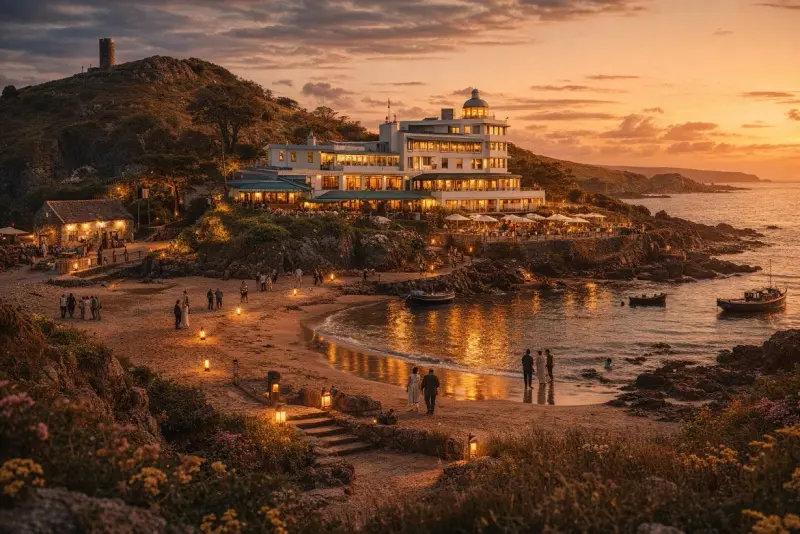
Britain's luxury hospitality sector is at an inflection point. Competition is higher than almost anywhere else in Europe, with nearly half of all hotel construction across the continent occurring right here in the UK and the pressure on margins is considerable. Yet for those willing to look beyond the conventional playbook, the opportunity is extraordinary. Setoff the coast of Devon, the Art Deco Burgh Island Hotel, owned by an investment group led by myself, has long occupied a special place in British cultural life. Our guestbook reads like a roll call of the twentieth century, from Agatha Christie and Winston Churchill to Jeremy Irons and Joan Collins. The setting is dramatic and the legacy considerable. Yet the task, from the outset, was never simply about preservation. It was about making the property work for both us and our guests.
Our strategy was not to dilute Burgh Island’s eccentricity but to celebrate it more fully. Rather than chasing the formula used by many global luxury brands, the focus has always been on atmosphere, heritage and experience. The hotel’s Art Deco character, sense of theatre and connection to its landscape are central to our offer. Unique details, from the Crittall stained glass windows and the Captain's Cabin salvaged from HMS Ganges, to live 1920s jazz in the Grand Ballroom give guests something that no chain hotel can match.
The approach reflects a broader shift in hospitality. Today, the most important question any hotelier can ask is not what makes their property competitive on price, but what makes it genuinely distinctive. Personalisation, sustainability and a sense of place are the three pillars that drive lasting loyalty. Burgh Island’s appeal lies precisely in the fact that it does not feel like anywhere else.
Sustainability is central to our commitment. At Burgh Island, we source over 80% of our kitchen ingredients from within a 30-mile radius, send waste products to local commercial recycling plants, and hold the Gold Award from the Green Apple Organisation for Conservation. We have also championed the ‘Turn the Lights Out’ campaign, bringing academics and business leaders together to push for meaningful action on energy consumption. None of this is window dressing, it is fundamental to the kind of experience guests are increasingly seeking, and to the kind of business worth building.
That philosophy has helped establish Burgh Island as a destination in its own right, attracting guests who see the stay as something memorable rather than simply comfortable.
Building Businesses Around Experience
My instinct to always try and create something fresh and distinct did not begin with the Burgh Island Hotel. It started with Office Space in Town (OSiT), my flexible office group. Like my approach to the Burgh Island Hotel, it was co-founded by my sister Niki and myself in 2009, on the belief that the atmosphere of a workplace matters as much as its price. It
OSiT was built on a model our parents pioneered when they opened one of the UK's first business centres in Northampton in 1979. The conviction then was the same as it is now, that the best workplaces are not simply functional, they are destinations. Well before hybrid working entered the mainstream conversation, the case was already clear: offices need to earn their place in people's working lives, not simply occupy it.
That thinking extends beyond design into a more fundamental question about how this sector is understood by the wider property market. Traditional valuation models were built around long leases and predictable rents, frameworks that do not adequately reflect how a flexible workspace actually generates value. With the market projected to reach between £62bn and £126bn in value yet estimated to be undervalued by as much as 20% under conventional methods, the stakes are considerable.
The valuation approach I developed to address this, now known as the Fuchs Formula, separates a flexible workspace's income into two tranches. The first is contracted income equivalent to market rent, is valued at a standard 5% yield. The second encompasses contracted and variable service income, meeting rooms, IT, reception, secretarial functions, which, given its more variable nature, is valued at an 8% yield applied to 80% of the remaining income. The logic mirrors what the hotel and student housing sectors have already established: that income from services requires its own valuation framework. The data supports the case. Average client tenure at our Liverpool Street centre runs to 40 months, hardly the transient model that conventional valuations imply.
Alongside property and hospitality, Gunner, our no- and low-alcohol canned cocktail brand. In many ways Gunner is a natural extension of how I have always thought about building businesses. Drinking habits are changing quickly, particularly in social spaces where people still want the occasion of having something well made in their hand, even if alcohol is not the focus. What interested me was the opportunity to create a drink that people would choose in its own right rather than see as a substitute. With Gunner, the aim has been to bring the flavour, balance and sense of occasion of a good cocktail into a format that is simple, consistent and easy to enjoy anywhere.
We have been fortunate to see the brand find a place in clubs, hotels and major sporting venues, environments where the experience surrounding the drink matters just as much as the drink itself. For me, that is the familiar thread that runs through my work. Whether it is a hotel, a workplace or a drink, people respond to products that feel considered and distinctive. Gunner is still growing, but the ambition is straightforward: to build a brand that feels modern, sociable and relevant to the way people want to spend time together today.
If there is one principle that has held true across everything I have done, it is that experience and identity are not extras in a business, they are the reason it succeeds.